Wind Mitigation Reports in Brevard: What the Inspector Documents
The inspector records what your home has. The insurance company decides what that is worth.
October 15, 2026 · 3 min read
In a coastal county like Brevard, the way a house is built can matter as much as its age when a hurricane is on the map. A wind mitigation inspection is how that construction gets written down. The inspector examines specific features that affect how well a house holds up in high wind, and records them on a standard form your insurance company can read.
It is not a pass-or-fail test, and it is not a repair list. It is documentation of how the house was built. What you do with it is send it to your insurer, who may use it to adjust the windstorm part of your premium.
What the inspector documents
The report covers a short, fixed list of features. Each one is something visible and verifiable, and each one gets recorded as it actually exists on your house, not as you hope it does.
- Roof covering: the type of material and how it is rated or installed
- Roof deck attachment: how the sheathing is fastened to the framing
- Roof-to-wall connection: what ties the roof structure to the walls
- Roof shape: hip, gable or a combination
- Opening protection: shutters, impact windows, impact doors and garage doors
- Secondary water barrier: a layer that limits water entry if the roof covering is lost
Roof covering and deck attachment
The inspector identifies the roof covering and looks for documentation or markings that show what it is. Then comes the roof deck, the plywood or boards under the covering. How many fasteners hold it down, what size they are and how far apart they are spaced affects how well the deck resists being pulled up. Some of that can be seen from the attic. Some of it takes evidence, such as permits, plans or photos from a roofing job.
Roof-to-wall connections
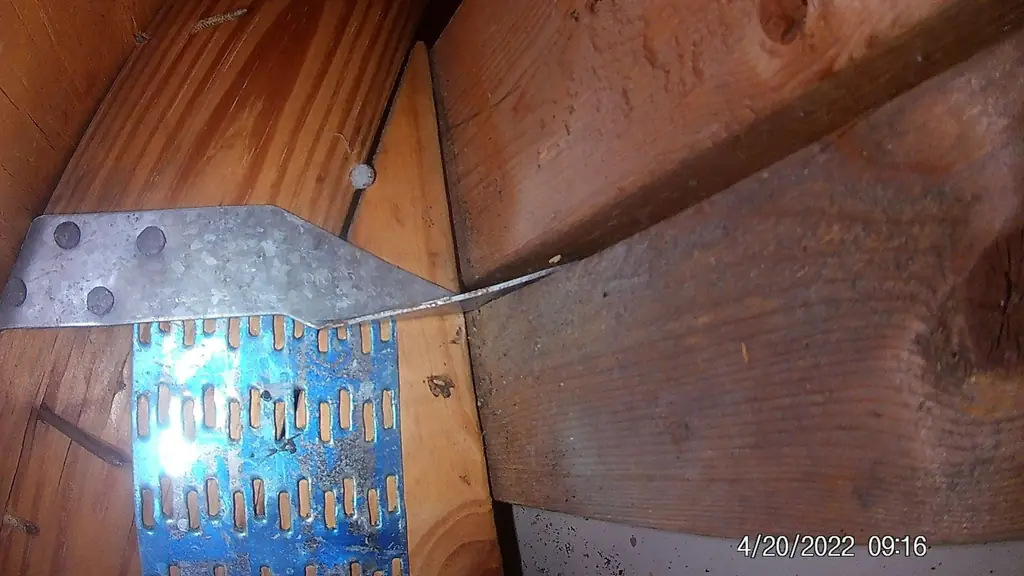
In a storm, wind tries to lift the roof off the walls. The hardware connecting the two, such as toenails, clips, single wraps or double wraps, makes a big difference. The inspector goes into the attic and looks at the connection at the trusses or rafters. A metal connector that is bent or pulled out of position is exactly the kind of detail that gets noticed and documented.
Roof shape and opening protection
Roof shape is easy to read from the outside. Hip roofs, with slopes on all four sides, generally hold up better in wind than gable roofs, and the form simply asks which one you have. Opening protection is the other visible item. Every window, door and garage door either has an approved protection method or it does not, and the inspector notes which type each opening has. A single unprotected opening can change the category the whole house falls into.
The secondary water barrier is a layer under the roof covering that helps keep water out if shingles or tile are torn away. Whether it is present and what kind it is can sometimes be seen from the attic, and sometimes only from evidence of how the roof was installed. If the inspector cannot verify it, it gets recorded as not verified, which is honest and keeps the report defensible if an insurer ever checks it.
Why the insurer decides the discount
This is the part owners often get wrong. The inspector does not grade your house and does not set a discount. The inspection produces facts. Your insurance company takes those facts, applies its own rating, and decides whether you qualify for a credit and how large it is. Two homes with the same report can end up with different results at two different companies.
That is also why the report has to be accurate. Marking a feature the house does not have can cause trouble later, and under-reporting a feature can cost you a credit you were entitled to. A careful inspector records what can be verified.
Getting ready for the visit
- Make sure the attic is accessible and clear around the hatch
- Gather permits, plans or paperwork from any roof replacement
- Locate documentation for impact windows, doors and shutters
- Ask your insurer which form and timing they require
Hoog's Home Inspections performs wind mitigation inspections for a flat rate anywhere in Brevard County. The inspector is Florida-licensed (HI13003) with 23 years of construction experience, so the attic connections get read by someone who knows how they are built. Call (321) 458-4816 to book.
Hoog's Home Inspections, (321) 458-4816
Call (321) 458-4816More articles
Florida Homes: 10 Expensive Issues a Home Inspector Can Find
A house can look perfect at the showing and still hide ten of the most expensive repairs a Florida owner faces.
Why a Brand-New Home Still Needs a Professional Inspection
Nobody has lived in a new house yet, but dozens of crews have worked on it, and any of them can miss something.